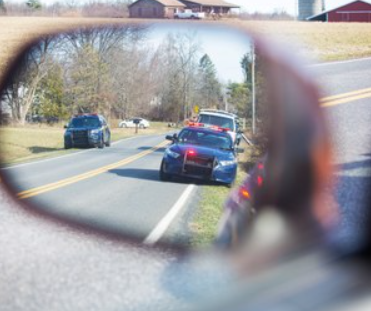
An alternative to vehicle pursuits
With StarChase, you just tag the suspect vehicle, then fall back and
wait
2/20/2010
Police Tech & Gear
with Tim Dees
 |
For as long as I can remember, police pursuits have been a delicate and controversial
topic. Pursuits are hazardous under the best conditions, and the best conditions
are seldom present. Banning pursuits sends the message to the criminal community
that compliance with police is optional. We have to face the reality that most
cops are not the drivers they think they are. Year after year, we lose as many
cops to vehicle wrecks as we do to felonious assault, and half of those are
single-vehicle accidents.
An adaptation of existing technology from StarChase offers an alternative to
the prolonged vehicle pursuit. StarChase’s solution places a locating
transmitter onto the fleeing vehicle. Officers can then monitor the
vehicle’s travel via a web browser, and corner the driver at a place of
their choosing when he believes he’s safe.
The StarChase solution consists of a launcher mounted on the front of the police
vehicle, loaded with two projectiles and a laser aimer. The driver of the StarChase-equipped
police vehicle targets the adjustable
laser dot from the aimer fixed to the front grille of the car onto the fleeing
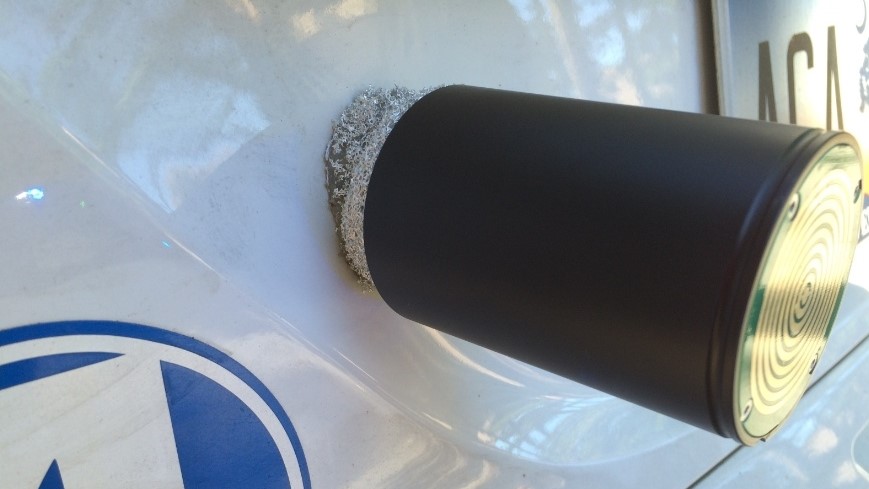
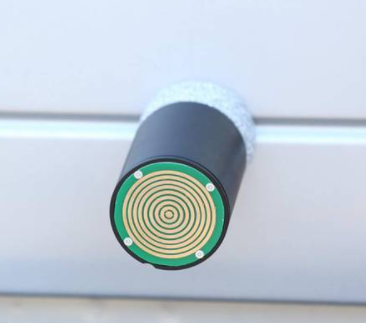
car’s body. When the officer activates the launcher, a projectile fires
and attaches to the suspect vehicle. When fired, the projectile begins sending
its location data via GPS satellite signal. The StarChase technology utilizes
advanced GPS technology that operates extremely well in both open and closed
urban environments. Once the location of the vehicle is identified, responding
officers can generally locate the suspect vehicle within 5-75 feet.
Once activated, the tracker’s location appears on a map in a secure web
browser. Officers in the field can track it in real time, or the information
can be relayed to officers from a communications center. The suggested tactic
is to fall back once the tracker is in place, then wait for the vehicle to stop
or travel to a location where it is easily immobilized or cornered. Batteries
in the tracker are good for at least six to eight hours, so there’s no
immediacy due to the limits of the system.
StarChase is in use at the Arizona Dept. of Public Safety (highway patrol).
In the deployments that have taken place as this is written (late November 2010),
the suspect vehicles have been located and recovered 100 percent of the time.
When I spoke with Steve Pass from StarChase, I wondered what would happen if
the bad guys just removed the tracker from the car. “The crooks haven’t
been aware they’ve been tagged. Even if they do discover it, it takes
some real effort to remove the projectile,” Pass told me. So far, the
speed of the police and suspect vehicles at the time the projectile is fired
has not been a factor.
StarChase offers grant-writing assistance for agencies interested in testing
and deploying the technology. The launchers and new or refurbished projectiles
are sold separately. Less-expensive “practice” projectiles are also
available, and use paintball pellets to show where the projectile hit. The costs
of using StarChase can certainly accumulate, but still cheap as compared to
the cost of wrecked vehicles, dead and injured officers and citizens, and civil
actions stemming from pursuits that go badly. If an agency can deploy a few
StarChase-equipped vehicles at a time and get them in position to tag the hot
car, extended pursuits are ended quickly and more safely for everyone concerned.
About the author
Tim Dees is a writer, editor, trainer, and former law enforcement officer.
After 15 years as a police officer with the Reno Police Department and elsewhere
in Northern Nevada, Tim taught criminal justice as a full-time professor
and instructor at colleges in Wisconsin, West Virginia, Georgia, and Oregon.
He was also a regional training coordinator for the Oregon Dept. of Public
Safety Standards & Training, providing in-service training to 65 criminal
justice agencies in central and eastern Oregon.
Tim has written more than 300 articles for nearly every national law enforcement
publication in the United Sttes. In 2005, Tim became the first editor-in-chief
for Officer.com, moving to the same position for LawOfficer.com at the beginning
of 2008. He now writes on applications of technology in law enforcement
from his home in SE Washington state.
Dees can be reached at tim.dees@policeone.com. |